Search has changed.
AI chatbots like ChatGPT, Claude, and Perplexity aren’t just answering questions anymore — they’re executing tasks, making purchases, and acting as full-blown digital assistants. Google’s AI Overviews now appear on roughly half of all search queries. Google’s AI Mode takes things even further, with 93% of those sessions ending without a single click.
Whether you call it AI SEO, GEO (Generative Engine Optimization), AEO (Answer Engine Optimization), or LLM SEO — it’s no longer a niche concern. It’s the core of modern search strategy.
We’re going to go ahead with “AI SEO” — the art and science of getting your brand recommended, cited, and trusted by AI systems — to keep things simple.
The numbers tell the story: organic click-through rates drop by 34–61% when an AI Overview appears.
Zero-click searches have surged past 58% in the US.
And yet, brands that are cited in AI Overviews earn 35% more organic clicks than those that aren’t. The opportunity isn’t disappearing — it’s shifting.
We’re going to assume you’re already sold on the value of appearing in AI — you’re a forward-thinking SEO after all.
We’ll break down the key strategies we’re using to appear in AI responses, plus some advanced additional tactics to boost your brand’s AI awareness.
AI SEO: How To Appear In AI Responses And Rank In AI Overviews
Build Brand Authority with Digital PR
AI SEO is to invest in high-tier digital PR to get your brand mentioned by authoritative publishers. Winning coverage in major media and niche trade sites does two things: it creates strong backlinks and spreads your brand’s exact messaging across the contexts where AI looks for answers.
Just like how regular SEO involves identifying key ranking factors and tailoring your site’s profile to those factors, AI SEO involves much the same — in this case leaning on how AI models factor in the trustworthiness and reputation of potential sources or recommendations.
AI models — whether they’re pulling from training data or performing real-time retrieval (RAG) — lean heavily on trusted, widely-cited sources to decide which brands to recommend. As Britney Muller, AI educator and consultant, has stressed: you need to focus on what you can actually influence — showing up in the historical training data and winning the real-time RAG layer through fundamental SEO and brand mentions at scale.
This isn’t theoretical. Research shows that Wikipedia is the single most cited source across all major AI tools — ChatGPT cites it in over 16% of responses, Perplexity at 12.5%, and AI Overviews at 8.4%. The top 50 domains on Google account for nearly 30% of all AI Overview citations. If your brand isn’t being mentioned on authoritative sites, AI has no reason to mention you either.
We’ve used this AI SEO tactic ourselves, using fatjoe’s own Digital PR Campaigns to target premium outlets like Forbes, MSN, NYPost and others to secure these mentions.
Just look at how it worked — we’ve been recommended on the back of ChatGPT picking up positive coverage we secured via a digital PR campaign.
Landing your story or expert quotes on such sites means AI crawlers (and Google’s knowledge overviews) are far more likely to “see” your brand.
In short, treating AI SEO visibility like a PR effort ensures your brand name and core phrases are replicated widely on the web.
Create Topical, High-Quality Content
Next, produce expert content on your brand’s core topics.
Again this AI SEO tactic builds on the fundamentals of regular SEO — it’s just about drilling down to the specific SEO factors that affect AI SEO too. But in 2026, there’s a critical additional layer: extractability. How cleanly can an AI system pull a precise, useful answer from your page?
Authoritative, in-depth blog posts aligned with your expertise not only boost regular SEO, they also fuel AI training data and real-time retrieval. AI doesn’t know everything — it regularly has to recrawl content to build responses to unique and ever-changing queries.
But here’s what’s changed: AI systems don’t read your content the way a human does. They process it contextually, looking for semantic richness, structured answers, and clear entity relationships. Research from AirOps found that comparison pages with 3+ tables earn 25.7% more AI citations, validation pages with 8+ list sections earn up to 26.9% more, and early-discovery content featuring 5–7 statistics earns a 20% higher citation likelihood.
You can leverage this by structuring your content for both humans and machines:
- Lead with clear, direct answers. AI favours content where the answer appears immediately after the question — not buried in paragraph four.
- Use Q&A-style headings. Structure key sections as questions (“What is…?”, “How does…?”, “Why should…?”) and put the answer directly below. This aligns perfectly with how people query AI and how LLMs select answers.
- Embed data and statistics. AI systems actively seek data-grounded content when generating responses, especially for early-category or informational queries.
- Keep content fresh and updated. AI search engines show a strong preference for recently published content. New, well-structured pages can start earning citations within days, not months. Many AI tools now use live web lookups, so being indexed by Google/Bing is still a prerequisite for citation.
Luckily, all the classic SEO techniques still apply. Fast page speed, mobile-friendly design, and clean site structure all help your pages rank quickly after publication, ensuring they can show up in real-time AI answers.
Similarly, on structuring your content, Mike King recommends implementing clear semantic units and Subject Predicate Object patterns to make content super-readable for AI. And Wil Reynolds is doing excellent work on “semantic distance” reporting — using vector embeddings to understand the gap between what you think your content covers and what AI perceives you as being relevant to.
Need help producing content that ticks all these boxes? fatjoe’s Blog Writing service handles the heavy lifting — from keyword research through to publication-ready content optimised for both traditional search and AI citation.
Listicles Are (Still) The Hotness: Earn “Best X” & “Top Tools” Mentions To Win AI SEO
This is possibly the most powerful AI SEO tactic to earn direct recommendations when ChatGPT and similar tools generate suggestions for services/products/anything else you offer — listicles.
Yepp, the 2014 classic — a good old ‘listicle’. Still going strong in 2026. Funny how that keeps happening.
Target the transactional queries too: get your brand in those coveted “best-of” and “top tools” lists.
When users ask AI for recommendations (e.g. “best email outreach tools”), the answers overwhelmingly draw from roundup articles or listicles. According to recent Wix research, 40.86% of commercial AI queries cite listicles as their source. By securing backlinks and mentions on these list pages, you ensure your brand is in the shortlist AI cites.
This is another classic SEO technique — funny how that keeps happening — but it’s absolutely worth the hard work you need to put in to secure these specific mentions.
Ahrefs calls it “Second Hand Search Traffic” — it’s a great way to appear in SERP real estate even for the most competitive terms — and now it’s arguably the most important AI SEO tactic for commercial queries.
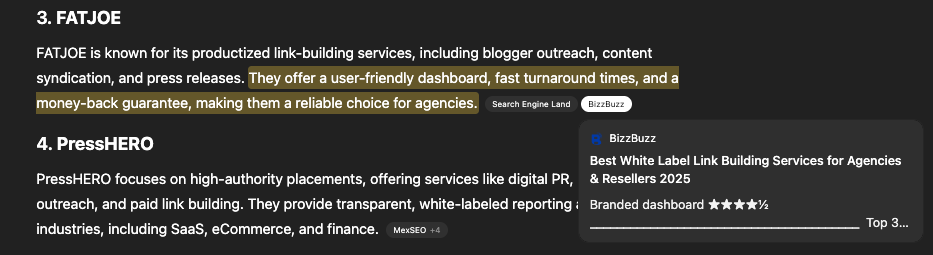
“But how do I get listed in these listicles?”
Easy — be the best choice for your niche within your industry.
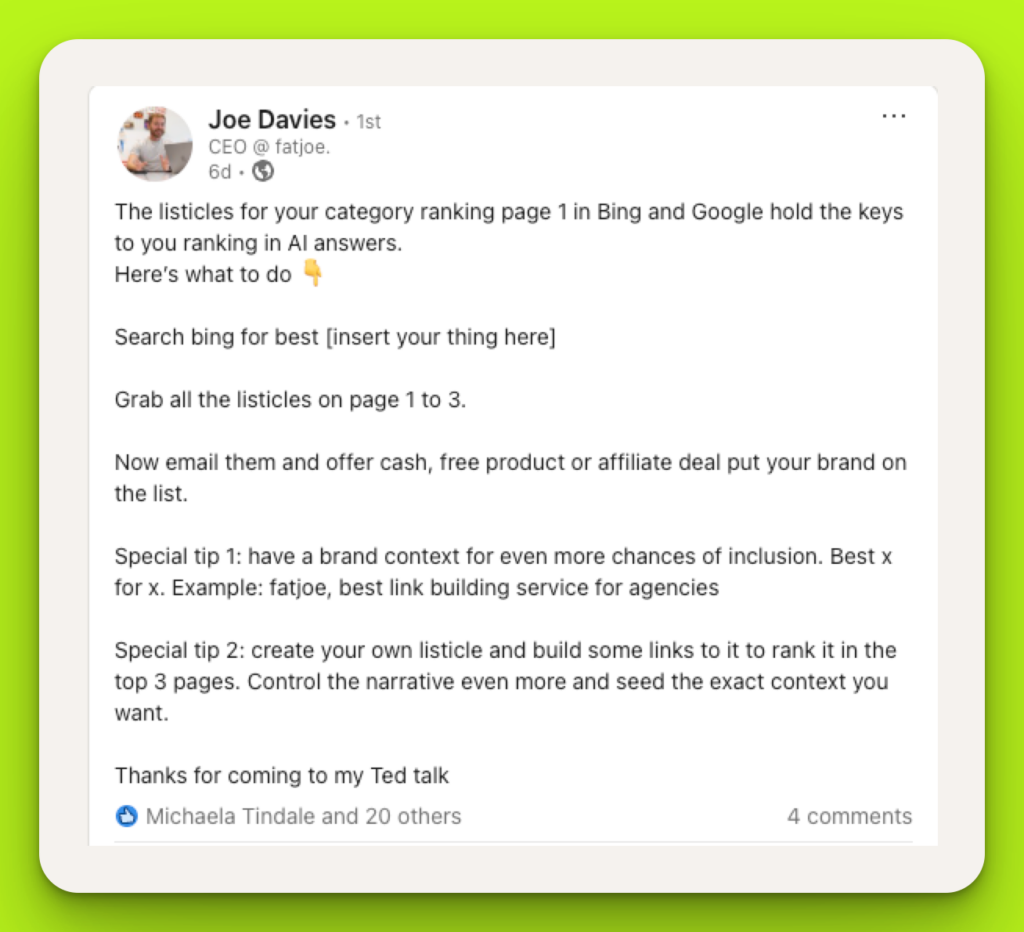
Not quite there yet? Follow Joe’s listicle outreach principles — identify the key “best of” lists ranking for your target queries, earn your spot through outreach and relationship building, and don’t forget to build your own listicles too!
Or, even easier, use fatjoe’s Brand Mentions service to secure positive coverage in reviews and listicles. This isn’t just a scattergun approach; it’s laser-targeted outreach for key terms, and it helps regular SEO too.
Appear In UGC Comments and Posts
UGC platforms are instrumental for AI SEO — and in 2026, they’re more important than ever.
Reddit and YouTube are among the most heavily cited domains across all major AI tools. Perplexity cites YouTube in 16.1% of responses and AI Overviews cite it at 9.5%. Reddit threads, YouTube content, and forum discussions now absorb roughly one-third of the traffic that AI Overviews leave behind.
This isn’t surprising when you think about how AI models work. They’re trained on massive web corpora, and Reddit/Quora threads represent authentic, diverse, human-generated opinions about products and services. When an AI system is asked “what’s the best X?”, it weights genuine community endorsements heavily.
You can manually work to build comments and posts mentioning your brand positively, but it’s hard work and liable to be removed by moderators if they consider it promotional.
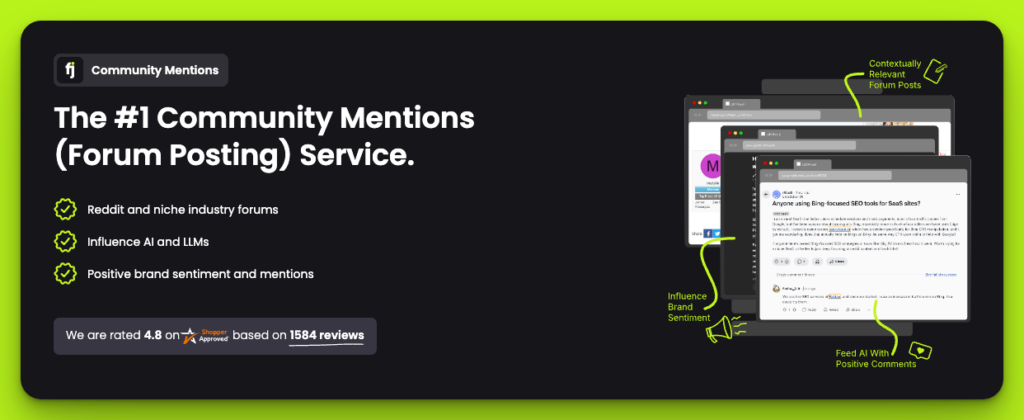
fatjoe’s Community Mentions service secures positive Reddit comments, Quora comments, and industry-specific forum answers to build your positive brand profile in AI. It’s one of the highest-leverage AI SEO investments you can make — getting authentic endorsements onto the platforms AI trusts most.
To bundle together both the afforementioned Brand and Community Mentions along with traditional link building powerhouses Blogger Outreach and Niche Edits check out our Grow Link Building Packages to master SEO and AI SEO the easy way.
Optimise for the Agentic Web (New for 2026)
Here’s where 2026 diverges sharply from the AI SEO playbook of even a year ago.
We’re moving into what industry leaders are calling the “agentic web” — where AI doesn’t just tell users which running shoes are best, it finds their size, applies a coupon, and executes the checkout. AI agents are now crawling the web not just to answer questions, but to act on behalf of users.
Jim Yu, CEO of BrightEdge, has highlighted the massive rise in agentic crawlers — AI that searches and acts on behalf of users. For SEOs, this means optimising for clicks is no longer the ceiling. You need to optimise for machine readability and API compatibility.
What this means in practice:
- If an AI agent can’t parse your inventory, pricing, or availability in real time, you won’t exist in this new transaction layer. E-commerce sites especially need to ensure product data is structured, accurate, and accessible.
- Product schema markup becomes critical — not just for rich snippets, but so AI shopping assistants can understand what you sell, what it costs, and whether it’s in stock.
- Consider building API endpoints that AI assistants can directly query. This is early-days, but protocols like the emerging “Agentic Commerce Protocol” point towards a future where your website serves AI agents as a primary audience.
In 2026, SEO is becoming two jobs: driving clicks from humans and supplying clean, trusted inputs for AI agents that may never visit your site through a browser.
This is still an emerging area, and we’ll be watching it closely. As these agentic capabilities mature, expect fatjoe to develop services that help brands optimise specifically for this new layer.
Additional AI SEO Tactics To Appear In AI Responses
The key summary here is: optimise your content to be “readable” to AI.
That isn’t quite the same as optimising for human readability, but luckily it’s close. Here’s what’s working in 2026:
- Manage your AI crawlers deliberately. Your robots.txt is no longer just about Googlebot. With GPTBot, ClaudeBot, PerplexityBot, and GoogleOther-Extended all hitting websites, you need to make deliberate decisions about which AI crawlers you allow. Be aware that Cloudflare’s Bot Fight Mode, enabled by default, may be silently blocking legitimate AI crawlers from accessing your content. Check your server logs.
- Consider implementing llms.txt. A new protocol has emerged: llms.txt, a Markdown-based file at your site root that gives AI systems a structured summary of your most important content. It’s controversial — there’s genuine debate about whether it influences AI citations — but only around 10–15% of websites have one. Whether it proves decisive or not, it takes under 30 minutes to implement and there’s no downside.
- Implement Schema Markup. This one is still up for some debate — after a flurry of recommendations SEOs are pushing back against schema as something that directly affects AI readability. The thing is, it’s still great for machine understanding of your content and would never harm your SEO/AI response optimisation, so it’s still worth it to invest in optimised schema markup. Focus on Organisation, sameAs, FAQPage, and HowTo schemas to help AI systems identify your entities and connect your brand to the right topics.
- Ensure consistency and entity alignment. Be consistent in how you mention your brand and core terms. LLMs literally count co-occurrences of words. If a phrase appears often with your brand, the model “learns” to link them. Use the same brand phrasing everywhere: your homepage, bylines, author bios, PR stories, and guest posts should all repeat your unique selling line or tagline.
We’ve covered before the value of semantic SEO but SEOs are going deeper than ever using vector embeddings and more to understand the semantic context of their own content, and the semantic gaps between what they feel they cover, and what AI feels they are relevant to.
Wil Reynolds is doing some great work on this with his case for “semantic distance” reporting.
- Track your AI visibility. Traditional rank tracking alone no longer captures the full picture. In 2026, you also need to monitor AI citation share (how often your brand appears in AI responses), AI referral traffic (visits from chat.openai.com, perplexity.ai, claude.ai), and log file analysis to see whether AI crawlers are actually hitting your site. Treat this as a distinct practice alongside your traditional SEO reporting.
AI SEO: It’s Just SEO, Jeff.
So, what do you need to do to appear in AI responses and to rank in AI Overviews in 2026?
SEO.
ALL of the “AI SEO” tactics above are regular SEO tactics we’ve been preaching — and using — for years.
Digital PR. Expert content. Listicle outreach. UGC engagement. Technical hygiene. Brand consistency. These have always been the pillars of good SEO. What’s new is the additional layer — optimising for machine extraction, preparing for agentic interactions, and measuring citation share alongside traditional rankings.
You can bring a more focused approach to your outreach, brand building and content creation to optimise SEO for AI specifically, but ultimately your best approach is to continue with quality SEO tactics.
Need help putting this into action? Explore fatjoe’s AI SEO services — from Digital PR Campaigns and Brand Mentions to Community Mentions and Content Writing — we’ve got you covered.
Become a Pro at SEO
Join 65,000 others and learn the secrets to SEO success with our weekly blog posts.