Tracking “prompt volume” for AI chatbots might sound like the next big thing in SEO.
After all, if people are asking ChatGPT or Gemini questions, shouldn’t we treat those like search queries and measure them?
If we can’t track keywords, don’t prompt volumes and “AI visibility” scores make the most sense as a substitute – as I’ve even suggested myself before.
Spoiler: Prompt volume is basically a mirage. It’s built on tiny data samples and wild extrapolations, not meaningful user demand.
In fact, obsessing over how often a prompt is used in AI could send you chasing ghosts instead of actual SEO value.
The Prompt Volume Illusion: Small Data, Big Extrapolations
Steve Toth surmised the current state of prompt tracking fantastically: “it’s not measurement – it’s guesswork on top of guesswork”.
Tools boasting they can tell you how often people “search” inside ChatGPT or other LLMs and chatbots are largely basing those numbers on a tiny panel of users and then multiplying the results like crazy.
Just think about it: only a small slice of people ever install the special browser extensions that track AI prompts.
You’re missing Safari users. No mobile users. Not even the people using the official ChatGPT app.
So what do these tools do? They extrapolate. If their panel catches 1% of all AI usage, they scale it up by 100× to pretend they saw 100%.
Go check out Steve’s full post on LinkedIn and give it the love it deserves – but he’s not the only one sounding this warning.
AI Prompts ≠ Search Keywords (Too Diverse and Fragmented)
Another big reason to stop obsessing over prompt counts: AI prompts are all over the place – and most of them have nothing to do with traditional search intent.
People use AI chatbots for everything.
We ask ChatGPT to help plan our vacations, draft our emails, come up with meal plans, do our homework, brainstorm ideas – you name it.
These prompts are often long, oddly specific, and personal. And guess what? “Commercial” or search-like queries are only a tiny fraction of this noise.
Imagine someone prompts an AI: “Write me a 7-day keto meal plan” or “Help me debug this Python error.”
Those might count toward “prompt volume,” but they’re not searches that lead to clicking a website.
They’re not the kind of intent that an SEO can capture – there’s no search result to rank for when the AI just gives the answer directly.
In other words, a high prompt count – assuming they can even account for the volume properly – doesn’t mean there’s traffic or value behind it; it might just reflect lots of people asking an AI to do something for them, with zero opportunity for your site to get a visit.
That’s not all.
Prompts are so diverse and phrased in endless ways that tracking them is, frankly, pointless.
Two people with the same goal might ask completely different prompts.
One might type “What’s the best budget smartwatch in late 2025?” and another might ask “Which cheap smartwatch should I buy for 2026?” – a traditional keyword tool would see these as the same intent, but a prompt tracker could log them as separate prompts.
One tool might count one phrasing, another tool counts a slight variation, and both pat themselves on the back for capturing “demand” – meanwhile, they’re possibly double-counting or misreading the real intent.
It’s a messy, fragmented picture that doesn’t translate into clear SEO insights.
Prompt count ≠ keyword value. Unlike Google searches – where 100 searches for “best SEO agency” implies 100 real opportunities to get clicked – 100 AI prompt mentions of “best SEO agency” might be just people chatting with an AI, many with no intention of visiting a site.
The prompts simply don’t mean what SEOs think they mean in terms of driving traffic or conversions.
So, Is Prompt Tracking Completely Pointless?
Not quite.
It absolutely shouldn’t be used as a definitive metric, and it’s no replacement for the old SERP ranking scores or keyword rankings.
Its value lies in directionality.
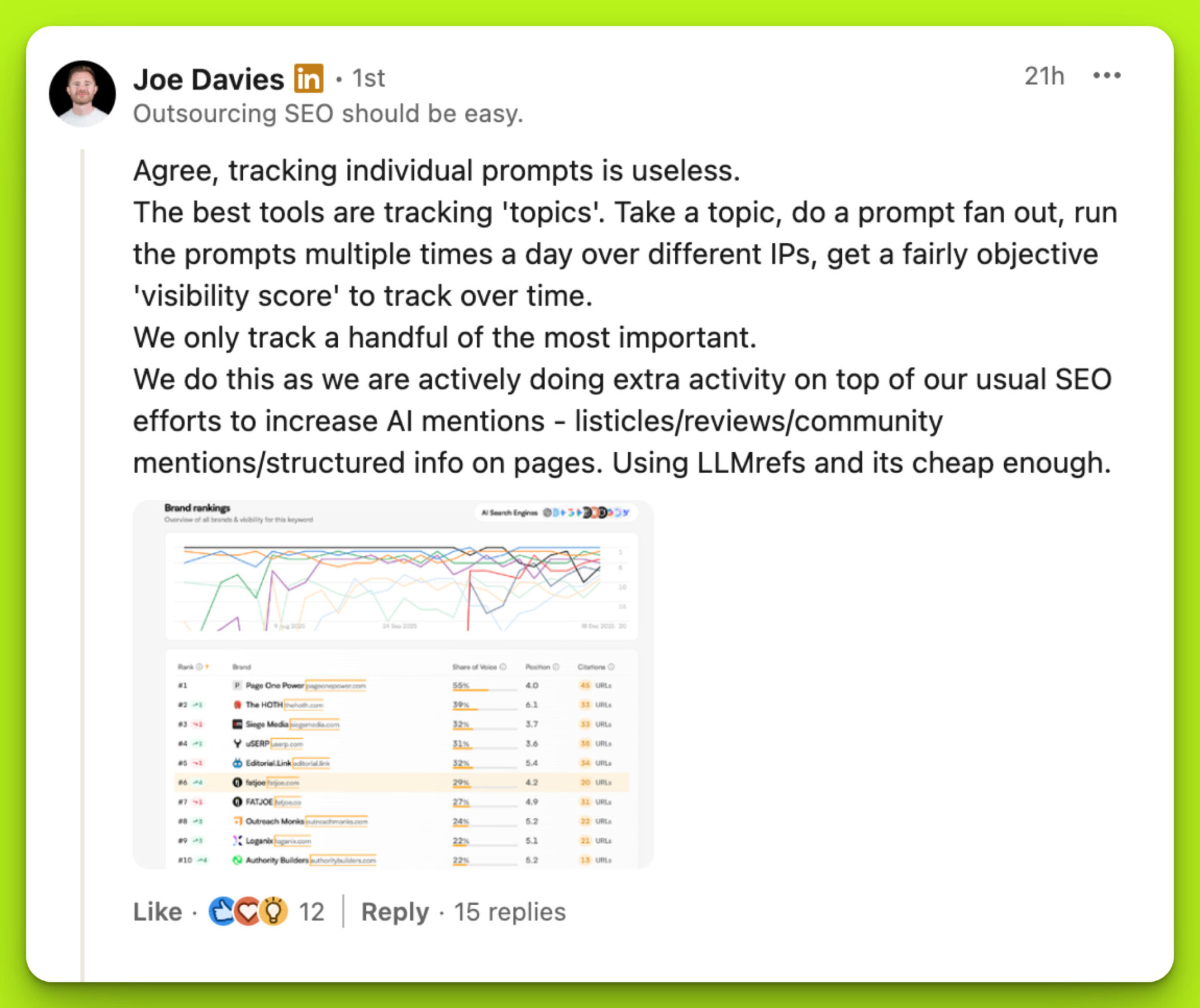
Tracking an array of prompts, mimicking query fanout, gives a general idea of your visibility.
Conclusively saying “We rank #1 in AI for outsourced link building” is a fools game, but if we tracked a series of prompts related to that and never saw ourselves pop up – well then we’d know we had a problem to fix!
It’s a useful directional pointer – but nothing more than that right now with the data sets available.
What to Focus on Instead: AI Visibility, Citations & Intent Alignment
Instead of chasing phantom metrics, smart SEOs are refocusing on what actually matters in the AI era. We suggest zeroing in on three things, broken down in this video here:
SEO obviously is evolving with AI, but one thing hasn’t changed: chasing fake metrics is a dead-end.
Prompt volume may look exciting, but it’s a shaky proxy for what SEOs truly care about – genuine demand, visibility, and results.
Instead of counting prompts, count the ways you can make your brand indispensable to the conversation.
Create content worth citing.
Build your authority.
Align with real user intent (not just what a stat says).
That’s how you’ll secure lasting SEO success, whether users are searching on Google, chatting with ChatGPT, or whatever comes next.
Become a Pro at SEO
Join 65,000 others and learn the secrets to SEO success with our weekly blog posts.