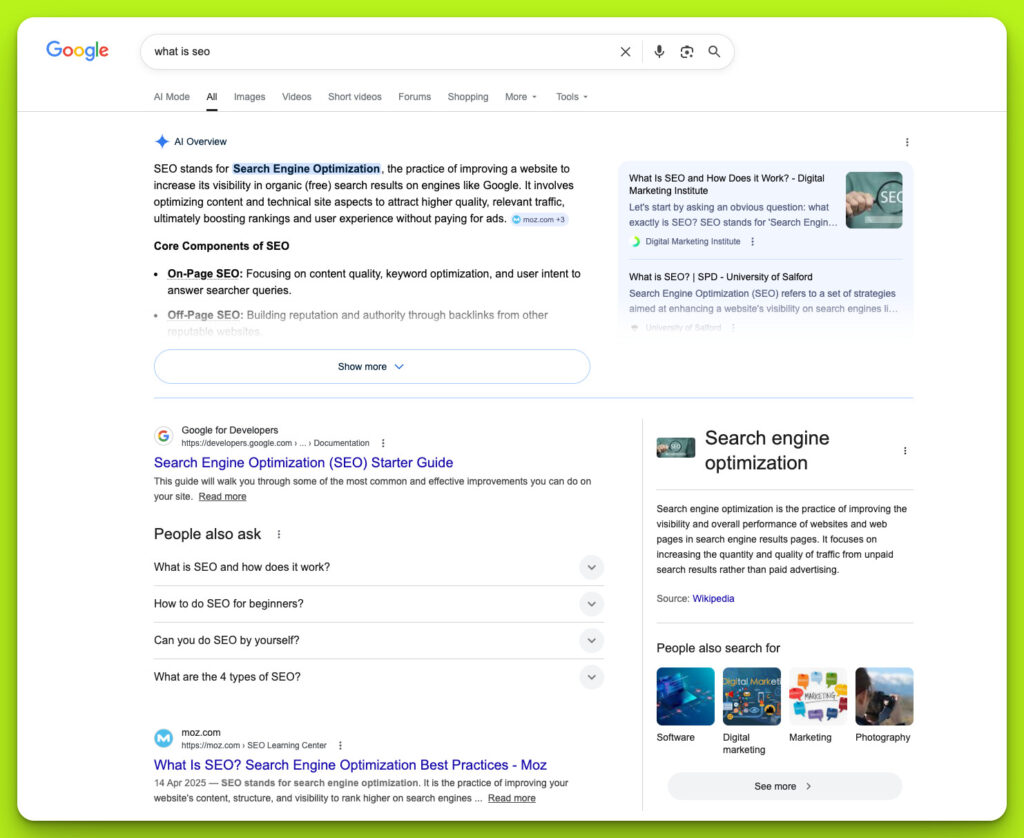
SEO stands for Search Engine Optimization.
It is the process of optimizing your website to be visible across search engines and AI-powered platforms. With proper optimization you are more likely to appear higher in search rankings – and increasingly, inside AI-generated answers – helping you get more organic, un-paid traffic and brand citations.
If you own a website or a business that operates online, you’re now probably taking SEO seriously or are at least ready to learn how it works and how you can apply basic SEO principles to your site.
Our guide to SEO for beginners will cover a no-nonsense, jargon-busting education on what SEO is, chapter by chapter, so you can understand and apply it to your website.
Oh and no, SEO still isn’t dead yet.
What is SEO?
SEO is the practice of optimizing your website and web pages to climb higher in Search Engine Results Pages (SERPs) and to be cited in AI-generated answers. The aim is to increase traffic in both quantity and quality – and in 2026, to increase your brand’s visibility wherever users are searching.
Ranking high in the SERPs enables businesses and brands to draw targeted traffic with a vested interest in their products and services. More targeted traffic means higher Click-Through Rates (CTRs). The increased exposure means you’ll get more attention from prospective customers.

You can even drive customers straight to specific pages on your website by offering detailed answers to the questions they are searching for. Applying basic SEO principles will allow you to drive targeted traffic to:
- Your homepage
- Your product pages
- Your blog content
Feeling lost with SEO terminology? Check out our SEO glossary here! We explain all sorts of SEO acronyms, abbreviations, and terms with simple-to-understand overviews.
Why is SEO Important In 2026?
The role of SEO has never been more important – or more complex.
Almost 90% of consumers use search engines to research a new purchase.
But in 2026, “search” no longer means just typing into Google.
Users are searching on AI assistants like ChatGPT and Perplexity, on TikTok, YouTube, Reddit, and more. Around 3 in 4 American users now say they search with AI weekly, and AI monthly sessions are now 56% the size of traditional search worldwide.
Crucially, traditional search has not declined – the overall pie has grown.
Total search usage combining search engines and AI platforms has increased by 26% worldwide. SEO is not dead; it has expanded.
Of traditional search users, 75% will never look beyond the first page of results, and around 30% of all search engine traffic still goes to the first organic result. But with zero-click searches (where users get their answer directly from an AI Overview or featured snippet without visiting a site) now accounting for nearly 60% of all Google searches, ranking on page 1 is no longer enough on its own.
This is why modern SEO must also focus on being cited, quoted, and recommended by AI systems – not just ranked in a list of links.
Understanding Search Behaviours (Micro-Moments)
The key to attracting new customers is to be in the ‘right place at the right time’. To do this, you need to understand your customer’s Micro-Moments – the intent-rich moments where a user instinctively reaches for their device or AI assistant.
If they want to learn something, buy something, or go somewhere, it creates an opportunity to engage them with helpful and relevant content.
Common micro-moments include:
- “I want to go” moments
- “I want to do” moments
- “I want to buy” moments
In 2026, these micro-moments increasingly happen inside AI chat interfaces rather than just on Google. Presenting users with high-quality, highly relevant content – structured to be cited by AI – positions you as the answer to users’ problems wherever they search.
Local, National, or International SEO?
SEO is like any other aspect of marketing. It needs a strategic and proactive approach tailored to the needs of your market.
Local SEO
Almost 50% of Google searches are for local businesses. If you run a café, restaurant, or boutique high street shop, you’ll need to adopt a localised approach. Ensure your Google Business Profile (formerly Google My Business) is kept fully up to date with accurate NAP data (Name, Address, and Phone Number).
Local SEO is especially vital for mobile users. Over 80% of smartphone users carry out “near me” searches. Inconsistencies in NAP data between directories can harm your local rankings and frustrate potential customers. Local link building – getting links from local government bodies, newspapers, and businesses – also adds credibility in the eyes of search engines.
In 2026, AI assistants also increasingly surface local recommendations. Collecting genuine customer reviews across Google, Trustpilot, and other platforms gives AI systems the data they need to recommend your business confidently.
National SEO
Many businesses want to use SEO to conquer their national market. There are no quick fixes at a national level – it requires consistent best practice and patient attention to the basics. Content quality, site authority, and a solid technical foundation are all non-negotiable.
International SEO
Achieving SEO dominance in another country is challenging, especially if that country has a different native language. Your first step should be to localise content properly – not just translate it. Use geotargeting with international-friendly URLs and the appropriate hreflang tags. Reach out to high-authority sources in your target country to improve international rankings.
How Do Search Engines Work?
The better you understand search engines, the easier it is to develop an SEO strategy that appeals to their priorities.
Search engines don’t search the entire internet in real-time. When users perform an online search, they’re searching through information that has already been logged and indexed. This is why results appear in fractions of a second.
Spiders and Crawling
Search engines use programs called spiders or crawlers to move throughout the web, following hyperlinks from page to page, logging data relevant to future search queries. If a page isn’t linked to elsewhere on your site, crawlers won’t find it. Broken links prevent crawlers from moving through your site and signal to search engines that your website may be poorly maintained.
Search Indexing
Once crawled, data is added to a Search Index – an enormous database from which search results are drawn. Keywords, structured data, and content quality all help search engines understand the relevance of your content.
Mobile Indexing
Google now operates on a mobile-first indexing basis, meaning the mobile version of your site is the primary one crawled and indexed. In 2026 this is standard – not optional. Your mobile experience must be fast, clean, and functionally identical to your desktop version. Best practices include:
- Keeping mobile and desktop content consistent
- Using identical meta titles and descriptions across versions
- Correctly formatting images for mobile
- Ensuring ads don’t harm the mobile experience
AI-Powered Ranking
Modern ranking algorithms go far beyond keyword matching. Google’s AI systems – along with AI search engines like Perplexity and ChatGPT Search – interpret the meaning and intent behind queries, not just the words. They understand context, evaluate content comprehensiveness, and assess brand trustworthiness signals gathered from across the entire web.
Search Engines Always Evolve
Search engines are always changing to provide better results. Rather than chasing every algorithm update, focus on the big picture: consistently high-quality, helpful, authoritative content. That is the most sustainable long-term strategy.
How to Do the SEO Basics
White Hat vs Black Hat
There’s a light side and a dark side to SEO. Black Hat SEO involves tactics that try to game search algorithms – and the risks far outweigh any short-term gains. Google can penalise or even de-index your site. Tactics to avoid include:
- Keyword stuffing
- Content spinning (copying content from other websites)
- Linking to low-quality or irrelevant sites
- Cloaked redirects
Stick to White Hat SEO. The results take longer, but they’re sustainable, and they protect your long-term rankings.
Keyword Research
Keywords remain one of the most powerful tools in your SEO arsenal. In 2026, it’s also critical to think about how users phrase questions to AI assistants – these are often more conversational and longer than traditional search queries.
Steps for effective keyword research:
- Think about the language your customers use – including the questions they might ask an AI chatbot.
- List 5-10 topic buckets and fill each with a mix of short-tail (e.g., “boots”) and long-tail keywords (e.g., “best boots for hiking in winter”).
- Check how competitors rank for your target keywords – low-competition, high-relevance terms are the sweet spot.
- Include question-based phrases (e.g., “What is the best…”, “How do I…”) to capture both traditional and conversational search traffic.
For a more detailed how-to, check out our comprehensive guide to keyword research.
On-Site SEO
Optimise Your Content
Plugins like Yoast can help you tailor your content for SEO – advising on keyword placement, readability, and meta descriptions. But remember: these tools are guides, not rulebooks. Always write for your readers first, not for search engines.
Your content needs to:
- Address genuine customer problems and concerns
- Provide real, actionable value
- Demonstrate expertise through depth and specificity
When content is genuinely useful, it earns longer dwell times, repeat visits, social shares – all positive signals to search engines.
Adding Fresh Content
Search engines favour websites that are regularly updated with new, high-quality content. Each new page or post creates additional internal links, improving crawlability and signalling that your site is actively maintained. In 2026, quality outweighs volume: one exceptional, in-depth article will outperform ten generic ones.
User Experience (UX)
UX has a powerful influence on SEO. A page load speed of just 5 seconds can increase bounce rates by nearly 40%. In an era of mobile-first browsing, users will not wait around for slow sites. Focus on:
- Fast page load speeds
- Intuitive, clean navigation
- Responsive design across all devices
- Accessible, easy-to-read layouts
E-E-A-T: Experience, Expertise, Authoritativeness, and Trustworthiness
Google’s quality guidelines have long emphasised E-A-T (Expertise, Authoritativeness, Trustworthiness). In 2026, the addition of a second “E” – for Experience – has become increasingly important. Search engines now reward content that demonstrates first-hand knowledge and lived experience, not just academic expertise.
What this means practically:
- Include author bios with real credentials and experience
- Back up claims with original data, case studies, or personal insights
- Build a brand presence that is widely recognised and searched for
- Earn citations and mentions on trusted third-party sites
AI systems use E-E-A-T signals to decide which brands to cite and recommend. Strong E-E-A-T is now as important for AI visibility as it is for traditional rankings.
Off-Site Link Building
The more trusted sources linking to a page, the more search engines regard it as authoritative. High-quality, relevant backlinks from high-Domain Authority (DA) sites remain one of the most important ranking factors.
A DA score of 60+ is excellent; 50-60 is good; 40-50 is average; below 40 is poor. Before pursuing link-building partnerships, use tools like Moz, Ahrefs, or SEMrush to assess a site’s authority.
Social Sharing
Social sharing doesn’t directly influence Google rankings but it improves your overall online visibility, builds brand awareness, and generates indirect signals that search engines value. In 2026, an active social presence also feeds AI systems – positive discussions about your brand on social platforms and forums inform how AI assistants perceive and recommend you.
AI SEO & Generative Engine Optimization (GEO)
This is the most significant development in SEO since Google itself. In 2026, simply ranking on page one is no longer the whole game. Users are increasingly getting answers directly from AI-generated responses – and if your brand isn’t cited in those responses, you may be invisible to a growing segment of searchers.
Generative Engine Optimization (GEO) – also referred to as AEO (Answer Engine Optimization) or LLMO (Large Language Model Optimization) – is the practice of optimising your content to be cited, quoted, and recommended by AI systems like Google AI Overviews, ChatGPT Search, and Perplexity.
Why GEO Matters
- Zero-click searches now account for nearly 60% of all Google searches
- ChatGPT now accounts for roughly 20% of search-related AI traffic worldwide
- AI Overviews link to an average of 13 sources per response – those sources drive significant brand exposure
Crucially, GEO differs from traditional SEO in what it optimises for. Traditional SEO earns you a click. GEO earns you a citation – your brand gets mentioned even when no click happens. Both are valuable, and the two strategies have significant overlap.
How to Optimise for GEO
- Write comprehensive, in-depth content. AI systems prefer content depth (word count and sentence richness) over brief answers. Thin content is less likely to be cited.
- Use structured, scannable formatting. Clear headings, numbered lists, and concise answers to specific questions make it easier for AI to extract and cite your content.
- Answer questions directly. Lead with a clear answer to the query before expanding into detail. This mirrors how AI systems synthesize responses.
- Build your brand’s wider digital presence. AI systems aggregate signals from across the web – reviews, social mentions, forum discussions, PR coverage, and third-party citations all inform whether your brand is recommended. Brands are 6.5x more likely to be cited through third-party sources than through their own domain alone.
- Ensure fast page load times. Content that loads faster is more likely to be included by AI systems.
- Earn coverage on authoritative third-party sites. This is the single most impactful way to improve AI citation rates.
Search Everywhere Optimization
In 2026, search no longer starts and ends with Google. Users are searching on AI assistants, TikTok, YouTube, Reddit, Amazon, Instagram, and countless other platforms. AI systems pull information from this entire ecosystem when formulating their responses.
Search Everywhere Optimization is the practice of ensuring your brand is discoverable wherever your audience is looking – not just on Google.
In practice, this means:
- Publishing short-form video content on TikTok and YouTube
- Maintaining an active, positive presence on Reddit and forums
- Collecting genuine customer reviews across multiple platforms
- Ensuring consistent, accurate brand information across every platform where you appear
If AI systems can’t find positive, consistent information about your brand across the web, they’re less likely to recommend you – regardless of how well your website is optimised.
Common SEO Questions
What is SEO and is SEO important in 2026?
SEO stands for Search Engine Optimization – the practice of optimizing your website to climb the rankings in search engine results pages (SERPs) and to be cited by AI-generated search responses. In 2026, SEO is more important than ever, though its scope has expanded beyond traditional Google rankings.
What are the types of SEO?
There are three core types of SEO: on-page, off-page, and technical SEO. On-page SEO is everything you can do to optimise the front end of your website. Off-page SEO is the process of optimising your presence externally (link building, brand mentions, PR). Technical SEO is optimising the backend for crawling and indexing. In 2026, a fourth dimension – GEO (Generative Engine Optimization) – has become critical for AI search visibility.
How can I learn SEO?
Start by understanding your goal and target audience. Follow the steps in this guide to develop the right strategy. Track key metrics like organic traffic, keyword rankings, click-through rates, and AI citation frequency. SEO fundamentals are simple to learn; mastery takes time and consistent practice.
Who needs SEO?
If you have a website that drives leads or conversions, you need SEO. SEO helps you stay ahead of competitors, build your brand, and attract customers – for free, sustainably, over the long term.
When should I use SEO?
SEO should be a continuous investment, not a one-off activity. It takes time to see results, and rankings must be regularly reviewed and maintained. Revisit your SEO efforts every few months to identify what’s working and where pages can be further optimised.
Final Takeaway
SEO in 2026 is both familiar and fundamentally new. The foundations – quality content, strong links, fast technical performance, and genuine expertise – remain as important as ever. But the landscape has expanded. AI-powered search is reshaping how users discover information, and brands that only optimise for traditional rankings risk missing a growing share of their audience.
The winning strategy is to do both: keep your SEO fundamentals sharp, and start building your presence in AI search through GEO best practices and Search Everywhere Optimization. Focus on building genuine expertise, a trustworthy brand reputation, and content that is genuinely useful to your readers – and both traditional search engines and AI systems will reward you for it.
Become a Pro at SEO
Join 65,000 others and learn the secrets to SEO success with our weekly blog posts.